


On April 24 2026, our Museum of TreeBeekeeping Culture reopened — a place that presents one of the oldest traditions in a modern and engaging way. The event marked the culmination of the more than two-year-long project “Treebeekeeping– Tradition Beyond Borders,” carried out by the our Brotherhood in cooperation with the Dzūkija National Park in Lithuania. The project “Treebeekeeping– Tradition Beyond Borders” (TPL00145) was co-financed by the European Union under the INTERREG Lithuania–Poland Programme. Although the project has not yet officially ended, the museum enlargement was the main task undertaken by our Brotherhood as a partner in the project.
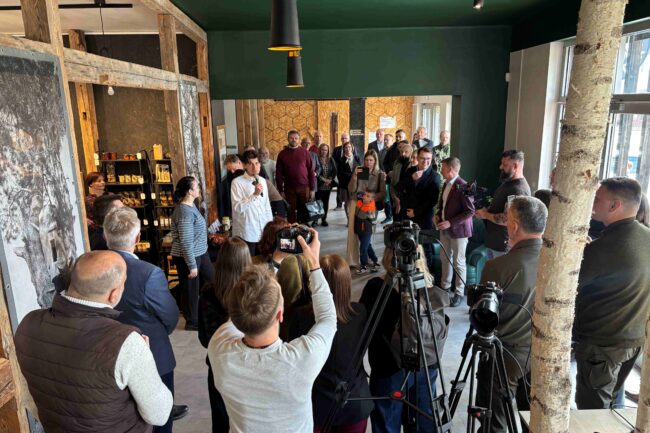
Opening of enlargement Museum of Treebeekeeping Culture 24.04.2026. Fot. Bractwo Bartne
For the museum opening, we sent and personally delivered more than 100 personalized invitations. Attendance was excellent, with over 80 participants. Among the guests were our partners from Dzūkija National Park, as well as representatives of the Biebrza, Wigry, and Białowieża National Parks in Poland. Representatives of local authorities from the City of Augustów, the Augustów County administration, and the Marshal’s Office were also present. We were additionally honored by visits from high-ranking representatives of the Ministry of Climate and Environment and the Ministry of Funds and Regional Policy — institutions thanks to which our project had the opportunity to be implemented at all. It was the Ministry of Funds and Regional Policy that supported us by granting a working capital loan for the implementation of the project. Friends and colleagues from beekeeping communities also gathered for the occasion.
Following the opening ceremony, and the guided tour throu the exhibition a conference was held during which researchers from various fields presented topics related to traditional forest beekeeping that they have been studying over recent years. The speakers included Professor Aivas Ragauskas from Vilnius University, who discussed issues related to treebeekeeping in the 17th century Grand Duchy of Lithuania; cultural anthropologist Dr. Karolina Echars, who has been observing Polish treebeekeeping from within the community; and evolutionary biologist Dr. Michał Kolasa, who researches bees dating back more than 1,350 years. Recordings of the lectures are available on our YouTube channel at the following link.
After the expansion, the museum now offers visitors an entirely new quality of experience.
So what exactly has changed?
The current exhibition simultaneously guides visitors through the history of forest beekeeping and the life cycle of a bee colony.
We successfully secured and displayed the two oldest known beehives in the world:
– a sarcophagus containing bees dating back more than 1,350 years, and
– a Vistulan beehive dating back over 1,500 years.
Interactive exhibits were also created to present both elements of beekeeping culture — such as lifting a beehive log using a traditional wheel mechanism — and aspects of bee life, including flower pollination.
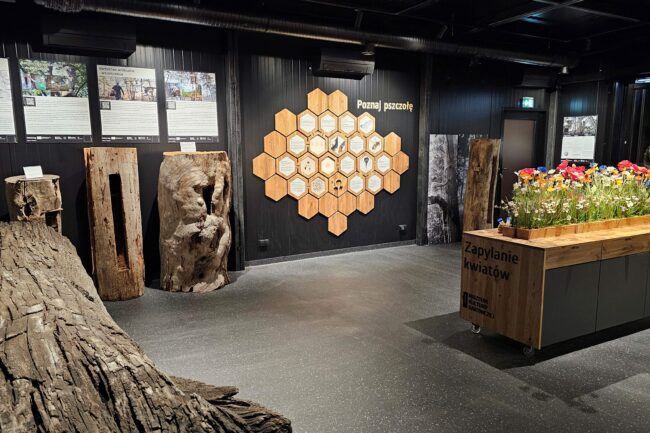
Fragment of new exposition with interactive elements of pollination and biology of the bee. Fot. Bractwo Bartne
More details on email and questions: fundacja@bartnictwo.com
by phone:
0048 601 542 516